Bridging Art, Politics, and Community
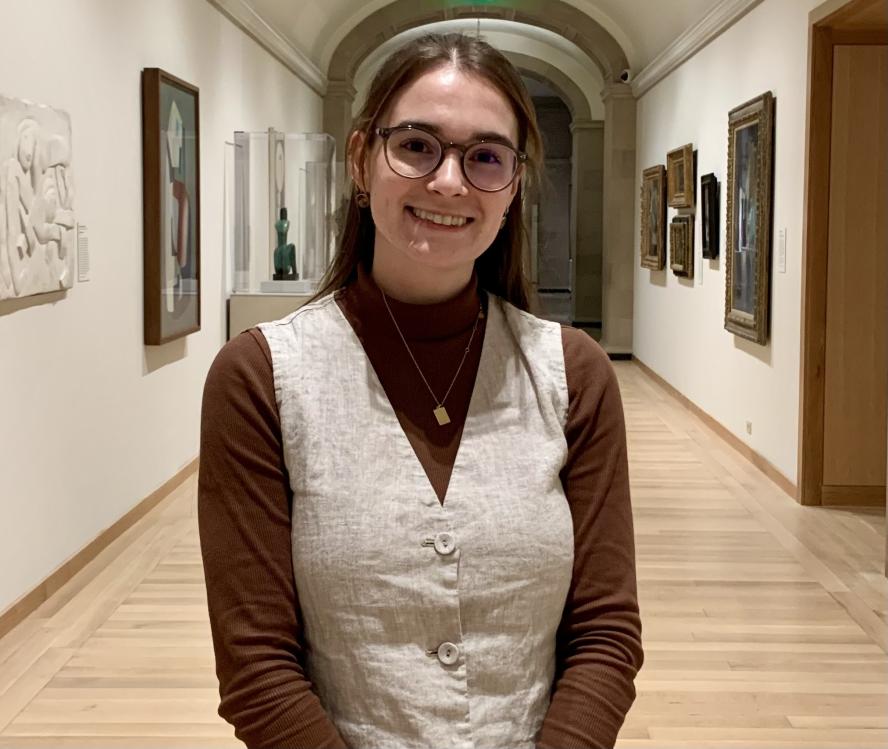
By: Maisie O'Brien
Kristen Lauritzen’s love of art began early with a fondness for Impressionism and Post-Impressionism. In fourth grade, she even dressed up as Vincent van Gogh for Halloween. “It was an objectively weird thing to do, particularly because it was my first year at a new school,” she recalls. “But Van Gogh has always stayed with me.” His work, she says, is uniquely revealing and unselfconscious, painted in bold strokes and strikingly beautiful colors.
She attended the College of William & Mary, where she double-majored in art history and government. After graduating, she served as an AmeriCorps member teaching in an elementary school, and later worked as a research assistant at a law firm. Ultimately, she decided to pursue a graduate degree in art history, realizing it bridged her interests in art, politics, and teaching.
At Tufts, Lauritzen focused on 19th-century European and 20th-century Latin American art. She was drawn to the MA in Art History program because of its strong reputation, its proximity to the New England art scene, and the generous scholarship funding she received. Upon graduation, she was awarded the Rhonda Saad Graduate Prize in Art History, recognizing outstanding academic excellence in the field as well as achievements in teaching, research, museum work, and community involvement.
What kind of research and teaching experience did you gain at Tufts?
During my second year in the program, I wrote two different qualifying papers, which allowed me to explore aspects of my research interests in depth. One was on the artist Georges Seurat and his circus paintings—so very much late 19th-century French Post-Impressionism—and my most recent paper was on Leonora Carrington, a British-Mexican surrealist painter.
I also gained valuable archival research experience interning at the Ogunquit Museum of American Art in Maine. The curator asked me to help with their upcoming exhibition catalogue by working on a chronology of the artist Carl Sprinchorn’s life. Because there wasn't a lot of previous research, I had to go through all of his notes, letters, and photographs, deciphering his messy handwriting. It was a newer aspect of research for me, but it was such a cool thing to look through, and the catalogue will be the defining volume on Sprinchorn.
On the teaching side, I was a TA for Intro to Architecture and French Art and Society, where I got to deliver a full-length lecture on Renoir and Degas—two artists I focused on during my internship at the MFA Boston this past year. I had never given a full-length lecture before, and ripping the band-aid off for public speaking was really scary. But once I got going, it was actually fun and reassured me that I know my stuff! The students were super supportive—they even clapped for me at the end, which was really cute.
Beyond coursework, I stayed busy with several community and museum internships that really helped me figure out my path. I interned at an art gallery in the SoWa district, and I volunteered as an exhibitions coordinator at the Center for Arts at the Armory in Somerville, where I was responsible for communicating with local artists, handling art, and curating and installing the gallery space. To take a break from school, I also spent the past two years working at Winter Hill Brewing Company in Somerville.
I am particularly proud to have co-founded Tufts’ first graduate art history journal, Ekphrasis, with a classmate. It features academic essays, book reviews, exhibition highlights, and a unique "Tufts Spotlight" section. It was a major learning experience, and I’m really happy with how it turned out and hope the first-years carry it forward!
Describe the community of faculty and students in the program.
I was looking for a supportive atmosphere for graduate school, and that’s exactly what I found at Tufts. Professors across the board were phenomenal—they are some of the best faculty I've ever learned from. I worked most closely with Adriana Zavala, Eric Rosenberg, and Andrew McClellan. They expected a lot from me, but they were also just really kind people to have in your corner. They're all such amazing teachers, and getting to hear someone who is so knowledgeable and passionate discuss their area of art just made me fall in love with it too.
The community itself has a cozy, quirky vibe, centered around our little art history house on campus. It used to be somebody's home, so one of the bathrooms even has a bathtub that no one uses! My cohort was pretty small, so it was important that we liked each other, and we all immediately did. All of us have very different areas of interest, and getting to hear about projects from a classmate who does contemporary art, for example, was really valuable to my own understanding of art history. We’ve all become good friends.
What’s next for you?
This summer, I'll be interning at the Phillips Collection in DC, which I'm really excited about. Then, I’m moving to Philadelphia to start a PhD program in art history at Bryn Mawr College, where I plan to study transatlantic networks of exchange of art and ideas across Europe and Latin America. My Tufts professors were so supportive throughout the application process. They read through my statement of purpose, gave me comments, and wrote letters of recommendation, which took a ton of the stress off the application process.
Looking further down the road, my goal is to go into either academia or curatorial work. Honestly, I don’t want to limit my options because it's a challenging job market; but having teaching experience in academia, combined with my museum internships, has shown me that I’d be really happy in either setting. Entering this new chapter, I feel like it’s important to be open-minded and embrace whatever comes next.